History of St. Wenceslaus
903 - 929 AD
"Good King Wenceslaus" of Christmas carol fame wasn't really a king, but he was saintly and good. Although there is no historical record of the story recounted in the Christmas carol. it is consistent with Wenceslaus' concern for the poor. In the carol, Wenceslaus and a page leave their castle to bring food and pine longs to a peasant on the feast of Saint Stephen (Dec. 26). As the wind grows more intense and the night grows darker, the page fears that he may collapse in the snow. Wenceslaus tells the page to follow his steps, which, miraculously, warm the page's freezing feet. Saint and page complete the trip to the peasant's home safely.
If saints have been falsely characterized as "otherworldly," the life of Wenceslaus stands as an example to the contrary: he stood for Christian values in the midst of the political intrigues which characterized 10th century Bohemia. Duke, martyr, and patron of Bohemia, born probably 903 (907) near Prague, in what is today the Czech Republic; died at Alt-Bunzlau (Also: Alt-Bunglou), 28 September, 929. He stood for Christian values in the midst of the world. His parents were Duke Wratislaw (Also: Ratislav), a Christian, and Dragomir (Also: Drahomira), daughter of the chief of the Veletians, a Slav tribe from the north. They had twin sons Wenceslaus and Boleslaus. Wenceslaus since he was the elder was sent to his grandmother St. Ludmila to be raised. Boleslaus remained with his mother.
At Budweis, Wenceslaus received a good Christian education from his grandmother, St. Ludmila, who sought to promote him as ruler of Bohemia in place of his mother, who favored the anti-Christian factions. The grandmother (also declared a saint) had been the daughter of a Slavic prince. She married Duke Borivoy of Bohemia, whom she followed into the Church. They built a church near Prague and tried unsuccessfully to force Christianity on their subjects. Many of the powerful Czech families became strongly opposed to the Catholic Religion. They wished to remain in their pagan beliefs. On the death of Borivoy in 915, his sons Spytihinev and Wratislaw ruled the whole country.
After the death of Wratislaw (Wenceslaus was still young when his father died in battle), Dragomir, acting as regent, opposed Christianity. Civil war broke out between the Christian and non-Christian factions. Grandmother Ludmila began urging Wenceslaus to take over. Hearing of the sedition, Drahomira kept Wenceslaus from Ludmila and reportedly caused her to be strangled to death while she was praying at Tetin in 860. Her Feastday is September 16th.
The resultant power struggle ended with the teenage Wenceslaus in charge of Bohemia, attempting to bring together the warring factions. As ruler, Wenceslaus attempted to reduce the oppression of the peasants by the nobility. He ruled from 921-929. His rule was marked by efforts toward unification within Bohemia, support of the Church, and peace-making negotiations with Germany, a policy which caused him trouble with the anti-Christian opposition. St. Wenceslaus cultivated friendly relations with Germany, and preserved the unity of his country by acknowledging King Henry I (the Fowler) as his over-lord around the year 926, (he placed his duchy under the protection of Germany), seeing in him the legitimate successor of Charlemagne. This caused a great opposition who formed a party against him. He introduced German priests, and favored the Latin rite instead of the old Slavic, which had gone into disuse in many places for want of priests. The Emperor Otto I conferred on him the regal dignity and title.
For religious and national motives, and at the instigation of Dragomir, Wenceslaus was murdered by his brother Boleslaus. Boleslaus invited his brother Wenceslaus to the Feast of Sts. Cosmas and Damian. While Wenceslaus was on his way to mass on the morning of September 28, Boleslaus struck Wenceslaus and they began struggling. Then friends of Boleslaus ran up and attacked him and stabbed him to death. Wenceslaus' last words were " May God forgive you, brother."
Although his death resulted primarily from political upheaval, Wenceslaus was hailed as a martyr for the faith. By the end of the century Wenceslaus was celebrated as the nation's patron saint. Three years later Boleslaus, having repented of his deed, ordered Wenceslaus's body to be moved to the Church of St. Vitus in Prague. The shrine became a place of pilgrimage. The gathering of his relics is noted in the calendars on 27 June, their translation on 4 March; his feast is celebrated on 28 September. Wenceslaus Square is the center of modern-day Prague, and became in 1989 the site of mass popular demonstrations that helped topple the Communist dictatorship.
St. Wenceslaus by his death did what he was unable to do while he was living. He made Bohemia Christian. Within thirty years of his martyrdom the Faith was so strong that Wenceslaus's friend, the Emperor Otto, gave Bohemia a bishop of its own with his seat in the Cathedral of Prague, where the good King lay in a shrine to which pilgrims came from all over Germany. At the beginning of the eleventh century St. Wenceslaus was already regarded as the patron of modern Czechoslovakia.
COMMENT: "Good King Wenceslaus" was able to incarnate his Christianity in a world filled with political unrest. While we are often victims of violence of a different sort, we can easily identify with his struggle to bring harmony to society. The call to become involved in social change, and in political activity, is addressed to Christians; the values of the Gospel are sorely needed today.
Sources:
The Catholic Encyclopedia, © 1913 by the Encyclopedia Press, Inc.
Saint of the Day, vol2, by Leonard Foley, OFM, © 1975, St. Anthony Messenger Press
Orthodox Family Magazine, biography of Saints Ludmila and Wenceslaus.
Electric Library Encyclopedia
St. Wenceslaus Church - a Brief History
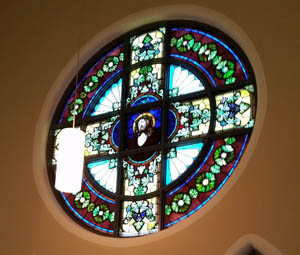 Dedicated 1893
Mid 1800's German, Irish, and Czechs immigrated to Iowa. They came to Iowa to claim their own land and flee political/religious oppression by the Austrians. Most were farmers used to farming small tracts of land. They got here by ship, oxcart, covered wagon, and later train to settle in the Midwest. They began buying small tracts of land in this area to build homes. One of the first Churches for the Bohemian people was in Cedar Rapids also called St. Wenceslaus. As it grew and more settlers moved west they added another church called St. Ludmilla. Names of St. Ludmilla and Wenceslaus were revered among the Bohemians because they where historical figures that represented their self-governance.
In Iowa City, the Bohemians were going to St. Francis Xavier Church until it burned down. Then they attended St. Mary's but the language barrier was difficult (at that time St. Mary's had mostly German homilies). In 1891 a Bohemian priest, Rev. Joseph Sinkmajer, was sent to help clear the language barrier. He would become St. Wenceslaus' first priest. By 1893 there was well over 2000 Bohemians in Iowa City. They settled around the St. Wenceslaus Church area. They were brick layers, masons, tin smiths, laborers, and carpenters. Many helped build St. Wenceslaus. Many homes around St. Wenceslaus were built by the Bohemians.
The Bohemians had large gardens and raised fowl for eggs and feathers. Geese especially were raised for down comforters. The Bohemians used geese feathers to dip into lard to make kolaches. Every morning the Bohemians would drive geese to the area near Oakland Cemetery to graze on the grass there. The geese would graze on grass during the day and in the evening they would be driven back home. The area eventually came to be known as Goosetown.
The land around St. Wenceslaus was purchased in 1892 for $825. Excavation for the new 40' x 80' building was begun April 15, 1893 (after the spring thaw) and was estimated to cost $7000. The contractor was Frank Novak. The original interior was completed in time for Midnight Mass on Christmas Eve 1893. It looks a bit different than today with the altar against the wall and a kneeling rail. The stained glass in the church was donated by parishioners. Two represent St. Ludmilla and St. Wenceslaus. The different styles are due to the original stain glass of 1892 and the stain glass in the addition done in 1921.
 In 1897 the rectory was purchased for $3300. Until that time Rev. Sinkmajer was residing in the rectory at St. Mary's.
In 1904 The Rev. Aloys Cihal arrived at St. Wenceslaus. He made many improvements during his time - most notably the installation of the pipe organ. The pews were numbered and parishioners had to pay a pew rental fee of $4 - $6 a year. This was considered a necessary obligation for a parishioner to sit in his numbered pew. This practice continued until at least the 1920's/1930's.
1912 the Rev Koerner was appointed to St. Wenceslaus. He was a serious gentleman and followed church custom of a "High Mass" and "Low Mass." The main difference was in the number of songs sung by the all girls choir (men's choirs wouldn't form for several years). During this time an organist was desperately needed for Christmas Eve and Morning Masses. Edna Englert--then only 15 years old--was asked. She agreed even though she knew only how to play only piano. Someone had to help her with the bellows.
Rev Panoch's years at St. Wenceslaus (1919 -1934) were filled with activity. In 1921 the addition/remodeling was completed. Much of the labor was contributed by the parishioners. Father Panoch himself laid much of the brick and helped pour the concrete foundation. Except for interior redecorating and moving the altar, the church has stood much as it is today. The addition to the church gave St. Wenceslaus a cruciform shape of early church architecture. This is the only church in Iowa City that follows this pattern.
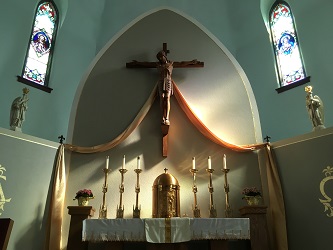
Father Neuzil (1934 -1970) grew up in St. Wenceslaus. He played a major role in the establishment of Regina High School. He served the longest term as pastor aided in his latter years by Father Bachman. During his time the church underwent changes such as a new paint scheme as well as a simple oak altar and crucifix and the change of the altar location. Masses were conducted in English instead of all Latin. The rectory also had an addition due to Father Neuzil's ailing health. The downstairs office today was originally a bedroom.
Msgr Madsen (1970 -1981) began a year long renovation in keeping with church guidelines. The communion rail was removed and the tabernacle was relocated to the side altar. Carpeting was added to replace the linoleum.
Rev. Joseph Denning (1981 - 1987) encouraged youth participation in mass. He was active on the Regina Board of Education and was on the Building Committee for the Elementary School at the Regina campus.
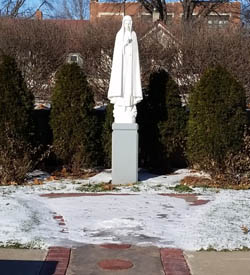
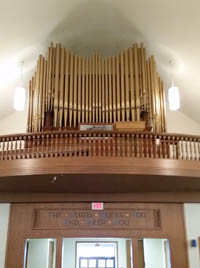 Rev. Harry Linenbrink (1987 - 1998) saw the original church organ of 1908 replaced - it could no longer be maintained. Under his guidance a committee was appointed to oversee procuring the Felgemacher organ we have today. The church windows were cleaned and a covering was placed on the outside to protect them. The altar area was renovated in 1992. He could often be found outside pruning trees and shrubs. He initiated the tuckpointing of the church as well as adding a walk from the church to the rectory with the marble bench in front of the Virgin Mary. He also helped establish S.H.A.R.E. which provides food at a reduced cost to those who contribute to community service.
Rev. Paul Deyo was pastor from 1998 -2000. He loved animals and would have a blessing of the animals - even stuffed ones on St. Francis' feast day. He also started the Parish Picnic with a baseball battle of the Padres and the Kings - funny how the score was always a draw. He also initiated the picture directory and the spirited contest for the Jubilee 2000 St. Wenceslaus logo.
Father Michael Phillips was pastor from 2000 until June 30, 2013. We appreciate his efforts in bringing Christ to the St. Wenceslaus community. His strong love for the church and his members was evident in all he did - especially his sermons. He also was instrumental in the building of the west entrance for the church.
Father Gary Beckman became pastor on July 1, 2013. He had been pastor of St. John in Houghton and St. James in St. Paul prior to his installation as pastor at St. Wenceslaus. Under his guidance, the sanctuary has been refreshed with tile flooring and fresh paint, a new sanctuary lamp and holy art, and gold leafing around the windows and near the tabernacle.
Information taken from Centennial, St. Wenceslaus Church Iowa City Iowa, 1893-1993